Lead generation for agencies without buying lists: how to find your next clients
Lead generation for agencies without buying lists: start from the clients you already won, find lookalikes in public places, and write to one decision maker at a time.
Scouty ·
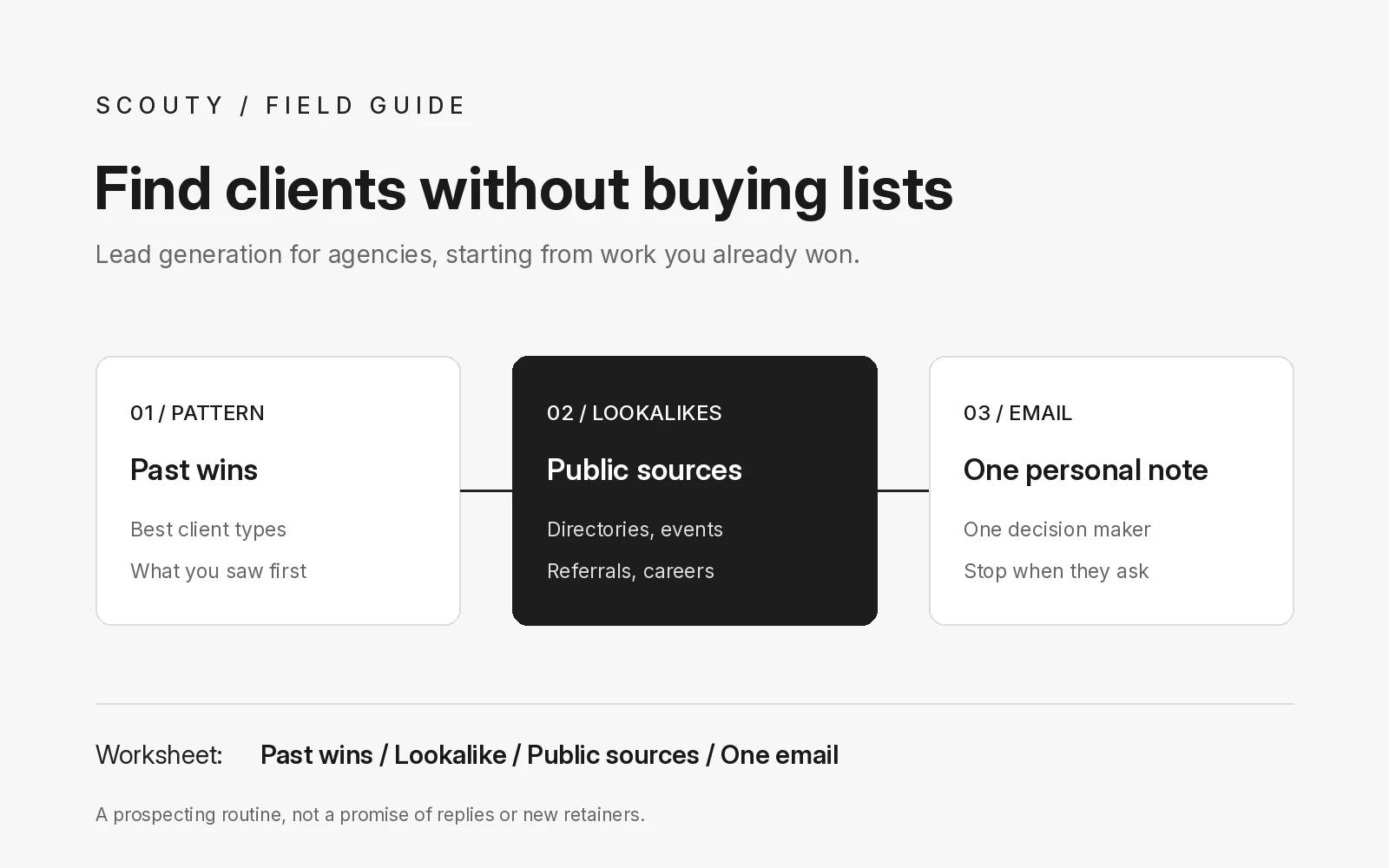
Lead generation for agencies does not have to start with a bought list. The clients you already won tell you more about who to approach next than any spreadsheet of strangers. This guide shows how to turn your best past work into a short list of lookalike companies, find them through public sources, and write to one decision maker at a time. You get a five-step routine, a copyable worksheet and one clearly labeled illustration. It does not promise replies, meetings or new retainers.
Bought lists are tempting because they feel like progress. But a list someone else assembled tells you nothing about why a company might need your agency, and it does not move legal responsibility away from you. The Australian regulator says you are still responsible for consent for any addresses you use, even from a list you bought. The UK regulator says the existing customer exception does not cover new contacts from bought-in lists. So the better question is not where to buy names, but how to find the companies you are already good for.
1. Start from the clients you already won
Open your last few good projects. For each one, write down what kind of company it was, what problem you solved, who hired you, and what you could see from the outside before they hired you. That last part matters most. A slow site, an old booking flow, a careers page hiring for a role you could support, or a new location announced on their news page are all things you can spot in another company too.
Look for the pattern, not the logo. If your three favorite projects were all independent physiotherapy groups with outdated websites, that is your starting niche. If they have nothing in common, pick the one type of work you most want more of and start there.
2. Describe one lookalike in a sentence
Turn the pattern into one sentence a stranger could use to find companies for you. For example: "Independent home services companies with one to three locations whose websites do not show prices or online booking." Add what makes a company a poor fit, such as a large in-house marketing team or a recent redesign. Our post on building a prospect list from your website uses the same starting point: who you help, then the companies that match.
Keep the niche narrow enough to recognize a fit from a company website quickly.
3. Find lookalikes in public places
Now go looking. You do not need a list vendor to find companies that match a clear sentence. Good public places to start:
- Your clients' own world. The suppliers, partners and peers your clients mention on their sites, and the trade associations they belong to, often publish member pages.
- Local and industry directories. Chamber of commerce listings, association directories and maps searches show companies by type and area.
- Event pages. Exhibitor and speaker pages for events in your niche list companies that care about the topic.
- Careers pages and job posts. A company hiring for a role close to your service may have the problem you solve right now.
- Referrals. Ask a happy client who else they know with the same problem, and only reach out if they point you there.
Check each company on its own website before it goes on your list. Write one line about what you saw that connects to your sentence. If you cannot write that line, leave the company off. For a worked example in one tight local market, see our guide to prospecting dental clinics as an agency.
4. Write to one decision maker with a real reason
At a small company, the person who can hire an agency is usually the founder, owner or the head of the function you support. Pick one person, not everyone on the team page. Our guide on how to find decision makers at small companies covers how to check that the person is current.
Then write one short, personal email. Say who you are, mention the specific thing you noticed in your own words, explain what you could look at for them, and ask one simple question. The cold email template a founder would reply to is a good structure. Identify your business, include accurate contact details, and make it easy to say stop.
This is not legal advice. Rules on commercial email differ by country and by whether you are writing to a company or a person, so read the ACMA guide to avoiding spam, the ICO guidance on electronic mail marketing and any rules where your recipients are, and get advice for your own situation.
5. Work in small batches and keep a record
Send to a small batch, then stop and look. For each company, note who you wrote to, what you said, the date, any request to stop, and what happens next. Follow up a few times at most, and stop as soon as someone replies, as explained in our post on cold email follow ups that stop when they should. If someone is interested, answer what they asked and keep the next step small, as in turning an interested reply into a booked meeting.
Before you widen the search, review the batch. If nobody engaged, change the niche sentence or the email before adding more companies. A steady weekly prospecting routine is easier to keep than a big push once a quarter.
Lookalike client worksheet
Copy this into a doc and fill it in before you search:
- Best past client type: ...
- Problem we solved: ...
- Who hired us (role): ...
- What we could see from the outside before they hired us: ...
- One sentence lookalike description: ...
- Poor fit signs: ...
- Three public places to search this week: ...
- One line I will write for each company before adding it: ...
- Where I record contacts and stop requests: ...
An illustration: Harbor and Pine Studio
Example, fictional agency: Harbor and Pine Studio, a three person web studio. Its two favorite recent projects were small family run plumbing and electrical companies whose sites did not offer online booking. The studio writes its sentence, finds lookalikes through a regional trades association directory and a maps search, checks each website for a booking option, and writes one note to the owner of each company that lacks one, offering a short review of their contact page. It skips companies that already book online.
Harbor and Pine Studio is an illustration, not a real agency, a customer or a measured result.
Where Scouty fits
Scouty at scouty.to is built for founders and small B2B teams without an SDR. You do not need a list of leads to start: you paste your website, and Scouty builds a first list of matching companies and decision makers from a B2B database. Each email is labeled verified, unverified or unavailable, as explained in our post on catch-all and verified email labels. Scouty writes one personal email per person, and you review it before it is sent. Optional follow-ups wait at least three days, send on weekdays, and stop when someone replies.
Scouty does not guarantee replies, meetings or new clients, and it does not replace your own judgment about fit or your responsibility to follow email rules. The Scouty FAQ covers how lists are built, email labels, follow-ups and meeting booking.
Questions about finding agency clients without lists
Is buying a list ever a shortcut?
It can look like one, but you still have to check every company for fit and you stay responsible for how you use the addresses. Starting from your own past work usually gives you a better reason to write.
How many companies should be in a first batch?
Small enough that you can read each website and write a line about it. There is no magic number. Pick a size you can review properly before the next batch.
What if my past clients have nothing in common?
Choose the kind of project you most want to repeat and treat that as your niche for now. You can test a second niche once the first has a routine.
Can I email everyone on a company's team page?
No. Choose the one person whose job matches your offer, and say why you chose them.
Sources and next step
Outside sources, checked 18 November 2026: ACMA, Avoid sending spam and ICO, Electronic mail marketing. Related reading on Scouty: lead generation for agencies: prospecting dental clinics, how to find decision makers at small companies, building a B2B prospect list from your website, and a cold email template a founder would reply to.
For product details, read the Scouty FAQ. To find companies and decision makers that match your offer, enter your website at scouty.to and review every email before it goes out.