Founder-led sales without an SDR: a weekly B2B prospecting routine
A weekly founder-led sales routine for B2B prospecting without an SDR: research one segment, review contacts, send personal emails and close the week cleanly.
Scouty ·
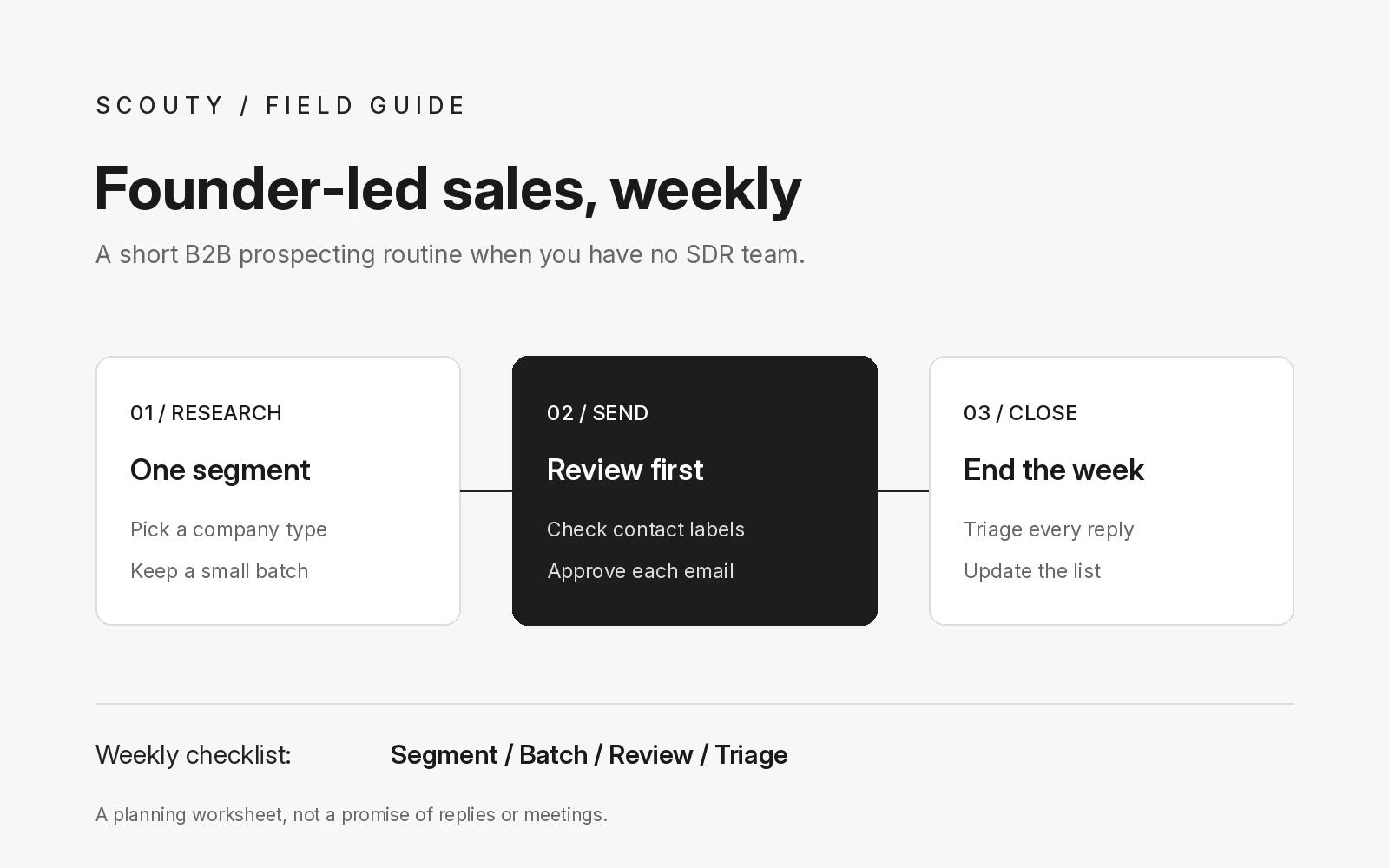
Founder led sales without an SDR team works best as a weekly B2B prospecting routine, not as a scramble whenever the pipeline looks thin. Block a few focused hours, research one clear company type, review a small batch of contacts, send a handful of personal emails, and close the week by handling replies and updating the list.
This guide is for founders and small B2B teams who sell themselves. The schedule, batch sizes and fictional company below are working illustrations, not measured results or a promise of replies or meetings.
1. Put founder-led sales on the calendar first
If prospecting only happens after every other fire is out, it rarely happens. Give founder led sales a recurring weekly slot, the same way you protect time for product or customer calls. A practical pattern for many founders is three short blocks: research early in the week, send midweek, and triage replies before the weekend.
Write the purpose of the slot before you open a tool. One sentence is enough: this week I research companies like X, contact people in role Y, and stop when batch Z is done. A clear stop keeps the session from swallowing the rest of the day.
2. Choose one segment and research a small batch
B2B prospecting without an SDR fails when every company type stays open at once. Pick one segment for the week: the same company criteria, one timing signal and a short exclusion list. Capture evidence for each candidate before you hunt for a person, using the worksheet in how to build your first B2B prospect list from your website.
Keep the batch small enough to inspect by hand. Ten companies is a useful starting exercise for a weekly pass, not an industry benchmark. Mark each as supported fit, uncertain or excluded. If most look uncertain, improve the criteria before collecting more contacts.
- Must-have company criteria: three facts you can check on a public page.
- Timing signal: one current clue that the problem might be active.
- Exclusions: two kinds of businesses you will skip even if they look similar.
- Likely role: the person who usually owns the problem at that company size.
3. Review contacts and email labels before you write
Company fit and contact confidence are different questions. After the batch looks solid, choose a relevant role and check whether a usable email exists. Treat verified, unverified and unavailable as confidence labels, not as proof that someone wants to hear from you. Our guide to catch-all email labels explains why an unverified address on a catch-all domain needs a second signal before you send.
If a contact is unavailable, do not invent an address from a naming pattern. Research another decision maker at the same company, or leave that account for a later week. Before you connect any sending tool, run the checklist in how to evaluate an AI prospecting tool before connecting your inbox.
4. Send a few personal emails and plan follow-ups that stop
Founder-led outreach works when each first email is reviewed by a person who knows the product. Aim for a short cold email with one specific reason, one problem framed as a guess, and one easy question, as in our cold email template for founders. Send only what you can stand behind if the person replies the same day.
Decide follow-up rules before the first send. A useful working plan is a short sequence with one new reason per message, fair spacing on working days, and a clear last note. Any reply, stop request or bounce should end the sequence. The full stop rules live in cold email follow ups that stop when they should.
5. Close the week: triage replies and update the list
The last block of the weekly routine is not more research. It is closing the loop. Read every reply in your own words. Record "not now" with the date they gave you. Honor every stop request immediately. Remove bounced addresses instead of guessing new ones.
Then update the list so next week starts cleaner than this one. Move supported-fit companies that still need a contact into research. Move interested conversations into a meeting brief, using how to prepare for your first prospect meeting. Leave excluded companies out rather than quietly loosening your criteria.
Copy this weekly founder-led sales checklist
Fill this in at the start of the week and check it again before you stop:
- Segment: the one company type I will research this week.
- Batch size: how many companies I will review before I stop researching.
- Evidence rule: every keep needs a public source, a date checked and a plain-language reason.
- Contact rule: what I do with verified, unverified and unavailable labels.
- Send limit: how many first emails I will review and send this week.
- Follow-up plan: stop rules, spacing and the date the sequence ends.
- Friday triage: replies handled, stop requests honored, list updated for next week.
An illustration: Northline Ops
Example, fictional company: Northline Ops, a three-person operations consultancy. The founder blocks Tuesday morning for research on mid-size software companies with a new self-serve product, Wednesday afternoon to review and send a few personal emails, and Friday morning to triage replies. On Tuesday she keeps eight companies with clear evidence and excludes two that sell consulting themselves. On Wednesday she sends to five verified contacts after rewriting each opener by hand, and parks two unverified catch-all addresses until she finds a second signal. On Friday one person replies "not my area, try our product lead." She thanks them, stops that sequence, and opens a fresh first email for the referral instead of dropping the new contact into the old follow-ups.
Weekly rhythm for Northline Ops: Tuesday research one segment, Wednesday review and send a small batch, Friday triage replies and clean the list. The numbers above are an illustration for one fictional founder, not a target.
Where Scouty fits
Scouty at scouty.to is a B2B prospecting and outreach tool for founders and small teams without an SDR. You enter a website to research matching companies and decision makers. Each email is labeled verified, unverified or unavailable. Scouty writes one personal email per person, and you review before sending.
According to the Scouty FAQ, optional automatic follow-ups are up to three messages, at least three days apart, on weekdays only, after you approve them in advance. Meeting booking can use Google Calendar when someone wants to talk. Scouty does not guarantee replies or meetings. Use the weekly checklist alongside the product so a fit score or draft never replaces your judgment.
Questions about founder-led sales without an SDR
How much time should founder led sales take each week?
There is no universal number we can source. Start with a block you can keep every week, even when the product calendar is busy. Protect research, send and triage as three separate jobs so one of them does not erase the others.
Do I need a big list before I start outreach?
No. A short list with a documented reason for every company is easier to review than a large list of loose matches. Expand only after your criteria find businesses you can honestly contact.
Should I hire an SDR before building a weekly routine?
Not necessarily. Many early teams learn which segment is worth hiring for by running founder led sales themselves first. A clear weekly routine also makes it easier to hand the work to someone later without losing the evidence and stop rules.
What if nobody replies this week?
A quiet week is information, not a reason to blast a larger list. Re-check fit evidence, message quality and contact labels. Do not promise yourself that more volume will create meetings.
Sources and next step
Related reading: build your first B2B prospect list from your website, catch-all email labels, cold email follow ups that stop when they should, a cold email template a founder would reply to, prepare for your first prospect meeting, and evaluate an AI prospecting tool before connecting your inbox.
For product workflow details, see the Scouty FAQ. To try the research and review flow on your own market, enter your website at scouty.to and review every email before it goes out.