Cold email template: how to write one a founder would reply to
A short cold email template built on one specific reason, one problem framed as a guess, and one easy question, plus a checklist to run before you send.
Scouty ·
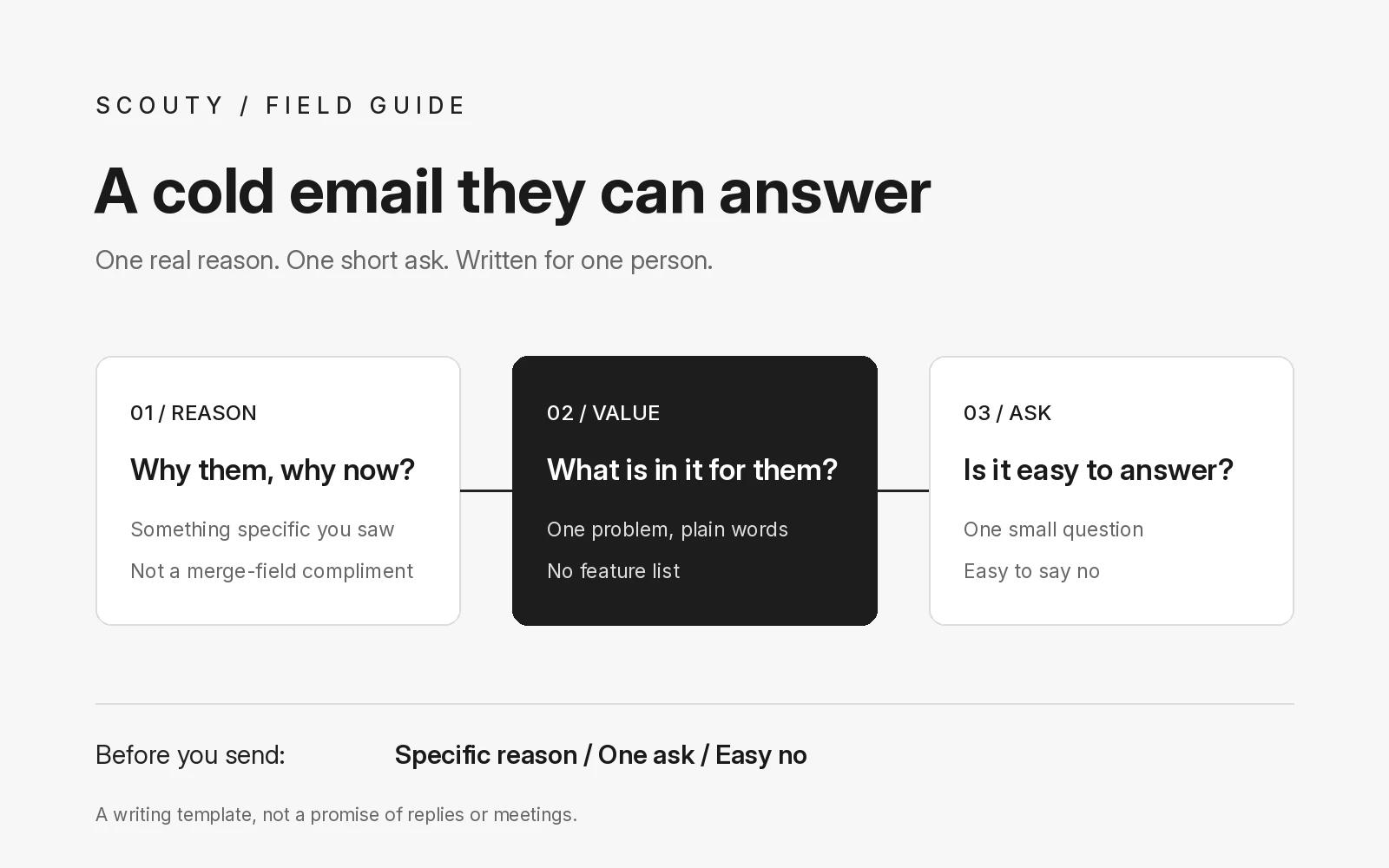
A cold email template is only useful if the person reading the email cannot tell you used one. This guide gives you a short cold email template built around three parts: a specific reason you are writing to this person, one problem you might help with, and one small question they can answer in a line. It also shows how to write a cold email from that template without it turning into a mail merge.
It is written for founders and small B2B teams writing personal outreach to a few people at a time. The example company, names and wording below are illustrations, not measured results. No template can promise a reply or a meeting, and this one does not try to.
1. Start with one reason that only fits this person
The first line decides whether the rest gets read. A useful opening is something you noticed about their company that made you think of them, written in plain words. It should be true, checkable and specific enough that it would make no sense sent to anyone else.
- Good: something on their website, such as a new service page, a team they are hiring for, or a market they just started serving.
- Weak: a compliment that fits every company, like "I love what you are building".
- Avoid: anything that feels like you watched them too closely, such as personal social posts.
If you cannot find a real reason in a few minutes, that is a signal the company may not be a fit yet. Building the list from fit first makes this step much easier. We cover that in how to build your first B2B prospect list from your website.
2. Name one problem, in their words, not your features
The second part connects your reason to a problem they likely have. Keep it to one or two sentences. Say what you think might be going on and be honest that it is a guess. Do not list features. The reader does not need to know how your product works yet, only why you thought of them.
Example: "Since you added a second location, I wondered whether finding new clinic partners is still done by hand from Google Maps."
3. Make the ask small and easy to answer
End with one question. The best asks can be answered in a sentence, including with a no. "Is this a priority this quarter?" is easier to answer than "Can we book 30 minutes next week?". A small ask respects their time and gives you a clear signal either way.
- One question only. Two questions usually get zero answers.
- Make no an acceptable answer, and say so if it helps.
- Do not add urgency you cannot back up, such as a fake deadline.
4. The cold email template
Here is the template. Fill the brackets from what you actually found, then read it aloud. If a sentence would fit any other company, rewrite it.
Subject: [their company] and [the topic in 2 to 4 words]
Hi [first name], I saw [specific thing on their site or in their company news]. It made me think [the one problem you guess they may have, framed as a guess].
We built [your product in one plain sentence] for teams like yours. [One line of proof you can stand behind, or skip it.]
Is [the problem] something you are working on right now? If not, no worries at all. [Your name]
Worksheet: check before you send
- Would the first line make sense sent to a different company? If yes, rewrite it.
- Is the problem framed as a guess, not a claim about their business?
- Is there exactly one question at the end?
- Is it under about 120 words, short enough to read on a phone?
- Is every claim about your product true today?
5. Plan the follow-ups and the stop rules before you send
A cold email is rarely the only message. Decide now how many follow-ups you will send, how far apart, and what ends the sequence: any reply, any stop request, or a bounce. Each follow-up should add one new reason, not repeat the first email. Our guide to cold email follow ups that stop when they should walks through this in detail.
Where Scouty fits
Scouty helps with the parts of this process that take the most time. You enter a website, and Scouty finds companies and decision makers that fit. Each email address is labeled verified, unverified or unavailable, so you know what you are sending to. Scouty drafts one personal email per person, and you review it before anything is sent. Follow-ups are capped at three, at least three days apart, on weekdays only, and meetings can be booked through Google Calendar.
Scouty does not guarantee replies or meetings. The template above still applies: you remain the person deciding what is true and worth sending. If you are weighing any tool for this, read how to evaluate an AI prospecting tool before connecting your inbox first.
Common questions
How long should a cold email be?
Short enough to read on a phone without scrolling, which usually means under about 120 words. Cut anything that does not support the reason, the problem or the ask.
Should I use the same cold email template for everyone?
Use the same structure, not the same words. The reason and the problem should change for every person. If they do not, you are sending a bulk campaign, not personal outreach.
What if they reply with interest?
Answer their question first, then suggest a next step. Our guide on how to prepare for your first B2B prospect meeting covers what to do before the call.
Sources and next step
Related reading: cold email follow up that stops when it should, build your first B2B prospect list from your website, and evaluate an AI prospecting tool before connecting your inbox. For common questions about Scouty, see the Scouty FAQ.
Want to try it on your own market? Enter your website at scouty.to and review every email before it goes out.