Lead generation for agencies: prospecting dental clinics (Melbourne example)
A five-step routine for agencies prospecting dental clinics, with a Melbourne example: pick one segment, research public sources, find who decides, check the Spam Act and Ahpra rules, then write one email per clinic.
Scouty ·
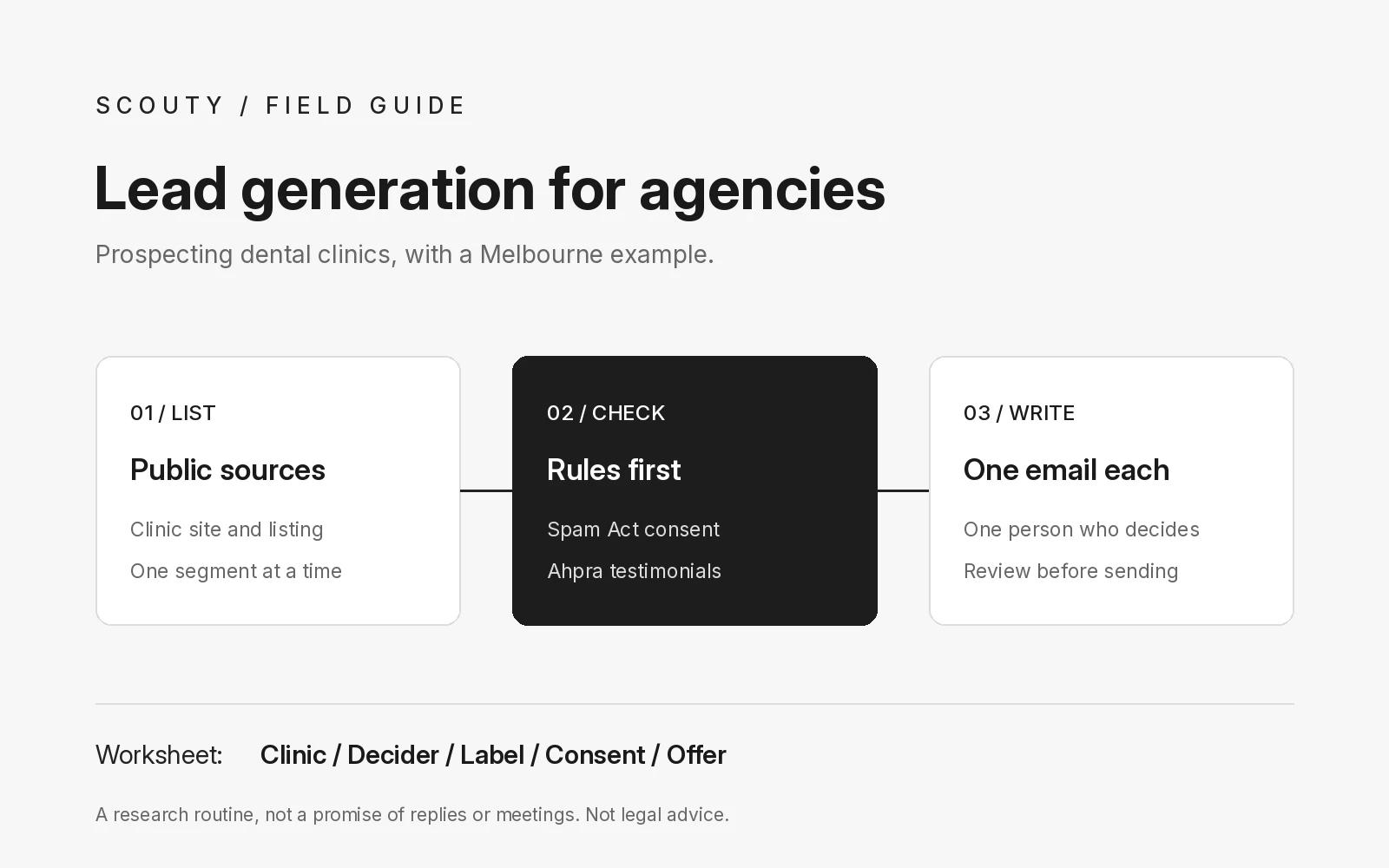
Lead generation for agencies works best when you pick one kind of client and get very good at finding and reading them. Dental clinics are a good example: they are local businesses, they have public websites, the owner is often a working dentist, and their marketing is regulated. This guide uses Melbourne as the worked example, but the same steps fit any city.
If you want the broader routine first, read our guide to lead generation for agencies without buying lists. This post applies it to one niche. You will get a five-step routine, a copyable clinic research sheet, and the rules to check before you send anything in Australia. The agency and clinic in the example are illustrations, not real businesses or measured results, and nothing here promises replies or meetings.
1. Pick one service and one kind of clinic
"We do marketing for dentists" is too wide. Choose one service you can explain in a sentence, such as a faster website, a clearer online booking flow, or a tidy Google Business Profile, and one kind of clinic to start with.
- General family practices usually care about steady new patients and an easy way to book.
- Specialist practices, such as orthodontics, often depend on referrals and on explaining treatment clearly.
- Group practices with several locations may have a practice manager or operations person who owns marketing.
Pick one segment for your first list and widen it later.
2. Build a short list from public sources
Start small: a short list of clinics you have actually looked at beats a long list you have not. In Melbourne, working suburb by suburb keeps the list manageable and lets you mention the area each clinic serves. Our founder-led sales weekly routine shows how to fit this into a week.
For each clinic, look at its own website first: the services page, the team page, the booking button and the contact page. Then check what a patient would see: the map listing, opening hours and how booking works on a phone. Note one concrete thing you noticed, good or bad, that relates to your service.
If you want to confirm that a named dentist is registered, Ahpra keeps a public Register of practitioners that includes dental practice. Use it to check facts, not as a source of contacts.
3. Find the person who decides
In a small clinic, the practice owner or principal dentist usually decides on marketing spend, and a practice manager often runs the day to day. In a group, look for a marketing or operations role.
Write to one person per clinic, not everyone on the team page. If the practice manager is clearly the right contact, write to them and do not copy the owner. Our post on how to find decision makers at small companies walks through how to confirm one current person before you write.
4. Check the rules before you send
Australia has specific rules for commercial email, and health services have specific advertising rules. Read the sources yourself before you send. This section is a summary, not legal advice.
The Spam Act 2003
The ACMA's guide to avoiding spam says you need consent before sending marketing emails, that each message must identify you as the sender and include your contact details, and that it must offer an easy way to unsubscribe. Unsubscribe requests must be honored within 5 working days, and the option must keep working for at least 30 days after you send. The ACMA also says you are responsible for consent even when you use a list someone else built, and that lists created with address-harvesting software must not be used.
Schedule 2 of the Spam Act 2003 says consent cannot be inferred just because an address was published. There is a narrow exception for an address that is conspicuously published, where the publication seems to have the owner's agreement, there is no statement saying they do not want unsolicited commercial messages, and your message is relevant to their work role. If a clinic's contact page says no marketing or sales emails, respect it. If you are unsure whether you have consent, get advice before you send.
Ahpra's rules on testimonials
Dental services are regulated health services. Ahpra's page on testimonials in advertising explains that the National Law does not allow testimonials about clinical aspects of a regulated health service in advertising, such as patient stories about symptoms, treatment or outcomes. It also says the advertiser is responsible for content produced on their behalf, including by a marketing agency.
For an agency, this shapes the pitch: skip "patient success stories" and offer things like clearer service pages or easier booking.
5. Write one specific email per clinic, then follow up carefully
Keep the first email short: who you are, the one thing you noticed on their site, the one service you offer, and a small question. Include your business name, contact details and a clear way to opt out. Our cold email template a founder would reply to gives a structure that works for agencies too.
Check the email address before you send. A verified address is safer than an unverified or catch-all one; our guide to catch-all and verified email labels explains the difference. If you follow up, keep it to a few polite messages spaced several days apart, and stop the moment someone replies or asks you to stop. See cold email follow ups that stop when they should.
Copy this clinic research sheet
One row per clinic. Fill it in before you write a single email:
- Clinic and suburb: name, suburb, website.
- Segment: general, specialist or group practice.
- Who decides: name and role of one person, and where you found it.
- Email and label: address, whether it is verified, and where it was published.
- Consent check: is the address published for this role, and is there any "no marketing" statement?
- What I noticed: one specific, kind observation tied to your service.
- My offer: one sentence, with no testimonial-based ideas.
- Status: reviewed, sent, follow up date, opted out.
An illustration: a Melbourne web agency
Example, fictional: a small Melbourne web agency, called Agency X here, decides to offer faster mobile booking pages to general family practices in the inner north. The founder checks each clinic website on a phone and notes that one example clinic, Clinic A, has a booking button that opens a PDF form. The team page shows Clinic A's principal dentist as the owner, and the contact page lists a practice email with no "no marketing" statement. The founder writes two sentences about the booking flow, offers a short call, includes the agency's details and an opt out line, and logs the send on the sheet.
Agency X and Clinic A are illustrations, not real businesses, customers or results.
Where Scouty fits
Scouty at scouty.to is built for founders and small B2B teams without an SDR, and agencies looking for their next clients fit that description. You enter your website, and Scouty finds matching companies and the decision makers there. Each email address is labeled verified, unverified or unavailable.
Scouty writes one personal email per person, and you review each one before it is sent. Optional follow-ups wait at least three days, go out on weekdays only, and stop when someone replies. Scouty does not guarantee replies or meetings, and you are still responsible for checking the rules in your market. The Scouty FAQ covers how it works and pricing.
Questions about prospecting dental clinics
Is cold email to dental clinics allowed in Australia?
It depends on consent. The Spam Act requires consent, and Schedule 2 sets out a narrow exception for conspicuously published work addresses when the message is relevant to the person's role. Read the ACMA guidance and the Act, and get advice if you are unsure. This is not legal advice.
Should I email the dentist or the practice manager?
Whoever owns the decision for your service: often the owner in a small clinic, while the practice manager runs operations.
Can I offer review or testimonial campaigns?
Be careful. Ahpra says testimonials about clinical aspects are not allowed in advertising regulated health services, and the advertiser is responsible for content an agency produces. Pitch services that do not depend on them.
Sources and next step
Outside sources, checked 16 November 2026: ACMA, Avoid sending spam; Spam Act 2003, Schedule 2; Ahpra, Register of practitioners; Ahpra, Testimonials: understand the requirements. This post is general information, not legal advice.
Related reading on Scouty: how to find decision makers at small companies, a cold email template a founder would reply to, catch-all and verified email labels, cold email follow ups that stop when they should, and turning an interested reply into a booked meeting.
For product details, read the Scouty FAQ. To find clinics or other companies that match your agency's offer, enter your website at scouty.to and review every email before it goes out.