How to find decision makers at small companies
A research routine for founders: start with the problem you solve, match company size to who decides, check the company's own pages and confirm one current person before you write.
Scouty ·
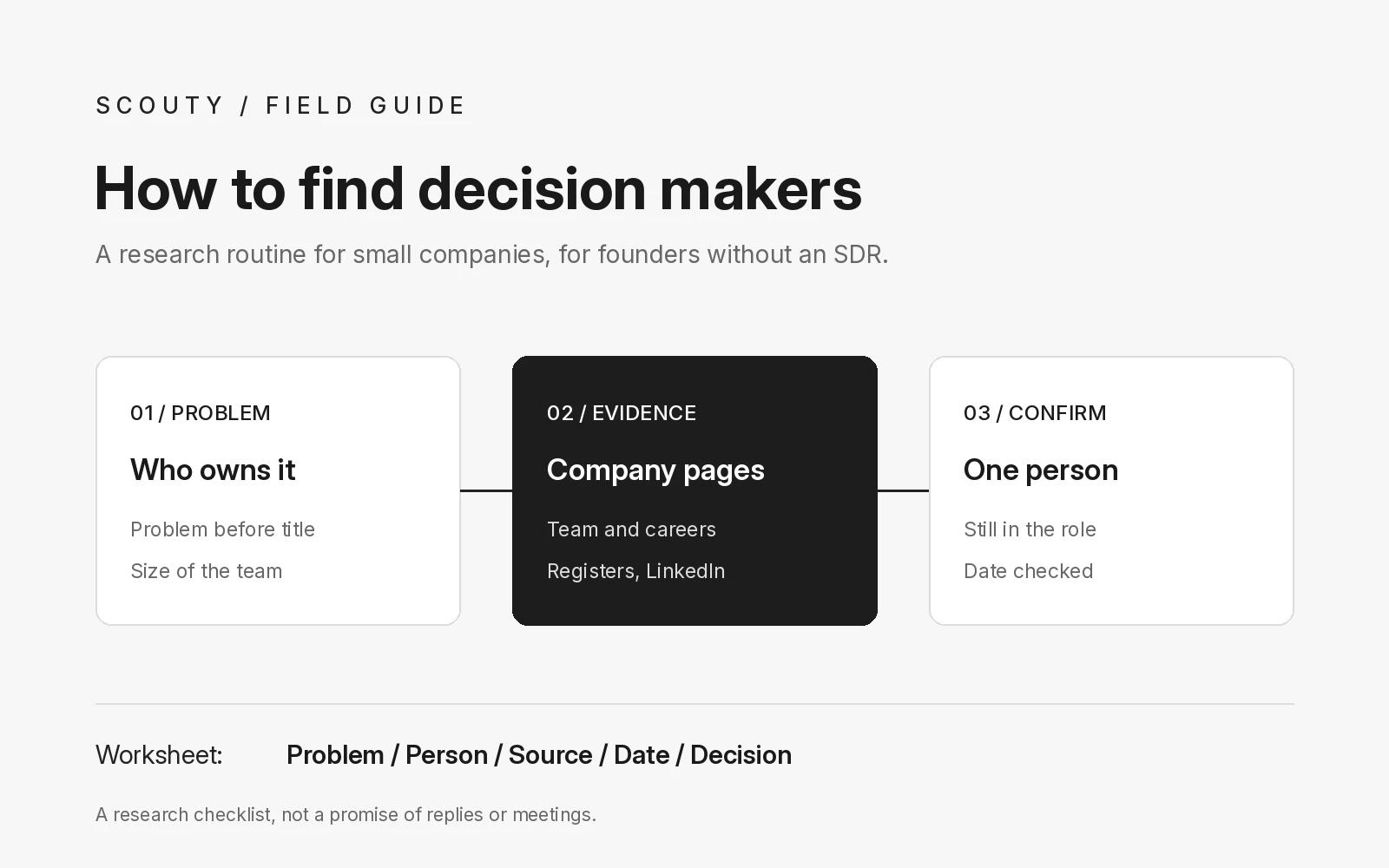
If you want to know how to find decision makers at small companies, start with the problem you solve, not with job titles. At a company of a few people, the person who feels that problem is often the founder or owner. As the team grows, the decision usually moves to whoever runs the function your offer touches. Your job is to find that person, confirm they are still in the role, and write down why you chose them.
This guide gives founders a short research routine and a copyable worksheet. The examples are illustrations and working rules, not measured Scouty results, and nothing here promises replies or meetings.
1. Start with the problem you solve
A title is a guess about responsibility. A problem is something you can check. Write one sentence before you research anyone: The person who would care about this is the one who owns [the process or result your offer changes]. If you help with onboarding emails, that owner might be the founder, a marketing lead or a product lead, depending on the company.
If you have not yet decided which companies to research, do that first. Our guide to building a B2B prospect list from your website explains how to record company fit before you look for a person.
2. Match company size to who usually decides
Small companies rarely have a buying committee, but they do have patterns. Treat these as starting guesses to verify, not rules:
- Founder-run teams: the founder or owner usually decides, and often does the work your offer touches.
- Small teams with a few functions: look for a head of the area you help, such as marketing, operations or engineering. The founder may still approve spending.
- Growing teams with managers: the function lead is the better first contact. Writing to the CEO about a narrow operational task can be a weak fit.
When you cannot tell which pattern applies, choose the person closest to the problem and note your uncertainty in the worksheet.
3. Check the company's own pages first
The best evidence about who does what usually comes from the company itself. Read these pages in order and note what each one actually says:
- Team, About or Leadership page. Names and roles the company chose to publish.
- Careers page. Job ads often say who a new hire reports to, which tells you who owns that area.
- Blog, press or podcast pages. A person who writes or talks about the problem in public is a strong candidate.
- Public company registers. In the UK, GOV.UK says you can get information about a company for free, including current and resigned officers. Officers are legal roles, so treat them as a clue about ownership, not proof of who buys.
- LinkedIn company pages. LinkedIn Help describes a People tab that shows employee job titles and how you are connected, and notes it only appears when at least one employee is associated with the page.
Keep the source link and the date you checked next to every name. A team page from two years ago is a lead to confirm, not a fact.
4. Confirm the person is current and relevant
Before you write anything, answer three questions. Is this person still at the company, according to a recent source? Does their role connect to the problem you named in step 1? Can you explain in one plain sentence why you are writing to them and not someone else?
If you cannot answer all three, mark the contact as research further. It is better to send fewer emails to people you can justify than many emails to people you guessed. Then check the email itself. Our explainer on verified, unverified and catch-all email labels covers what each label means and what to do with it.
5. Pick one person, then stop researching
At a small company, emailing several people about the same thing can feel like pressure. Choose one decision maker per company for your first email. Record a second name only as a fallback, in case the first person tells you someone else owns the area.
Set a time limit per company so research does not eat your week. When the limit runs out, either pick the best-supported person or move on. The founder-led sales weekly routine shows how to fit this research into a fixed weekly slot.
Copy this decision maker worksheet
Fill in one row per company:
- Company and website: ____
- Problem we solve for them: one sentence from step 1.
- Size pattern: founder-run, small team or growing team, and why you think so.
- Chosen person and role: ____
- Evidence: source link, what it says, and the date checked.
- Still current? Yes, no or unsure, with the source.
- Why this person: one plain sentence.
- Email label: verified, unverified or unavailable.
- Fallback name: only if you found one, with a source.
- Decision: contact, research further or exclude.
An illustration: Fernwood Bookkeeping
Example, fictional company: Fernwood Bookkeeping, a small firm with a team page listing a founder and an operations manager. You sell a client onboarding checklist tool. The careers page advertises an onboarding coordinator who reports to the operations manager. That ad links the onboarding process to her, so she becomes your chosen person, with the founder as a fallback. You record both sources and the date, and you confirm on her LinkedIn profile that she is still in the role before writing.
Fernwood Bookkeeping is an illustration, not a customer or a measured result.
Where Scouty fits
Scouty at scouty.to is built for founders and small B2B teams without an SDR. You start with your website, and Scouty researches matching companies and decision makers for you. Each email is labeled verified, unverified or unavailable, and people without a usable email cannot be emailed.
Scouty writes one personal email per person based on their role and company, and you review the first email before it goes out. The worksheet above still helps: use it to check whether each suggested person fits the problem you named. Scouty does not guarantee replies or meetings. The Scouty FAQ covers data, follow-ups and pricing.
Questions about finding decision makers
Should I always email the CEO of a small company?
Not always. At a founder-run company the founder is often the right person. Once there is a lead for the area your offer touches, that person is usually closer to the problem and better placed to judge it.
What if I find two people who could both decide?
Pick the one whose role is closest to the problem and keep the other as a fallback. If the first person points you to a colleague, follow that lead instead of writing to both at once.
How do I know a decision maker is still at the company?
Look for a recent source, such as a current team page, a recent post or a profile that lists the company as present. Write down the date you checked. If nothing recent confirms it, mark the contact as research further.
What should my first email say once I find the right person?
Name the public observation, the problem you can help with and one modest question. Our cold email template a founder would reply to walks through it.
Sources and next step
Outside sources, checked 11 November 2026: GOV.UK, Get information about a company and LinkedIn Help, LinkedIn Pages for members. Related reading on Scouty: building a B2B prospect list from your website, catch-all email labels, founder-led sales weekly routine, a cold email template a founder would reply to, cold email follow ups that stop when they should, and Apollo alternatives for founders.
For product details, read the Scouty FAQ. To see which companies and decision makers match your offer, enter your website at scouty.to and review every email before it goes out.