Turning an interested reply into a booked meeting
A five-step routine for founders: read what the prospect actually asked, reply the same working day, offer specific times, confirm with an invite and agenda, and nudge only once.
Scouty ·
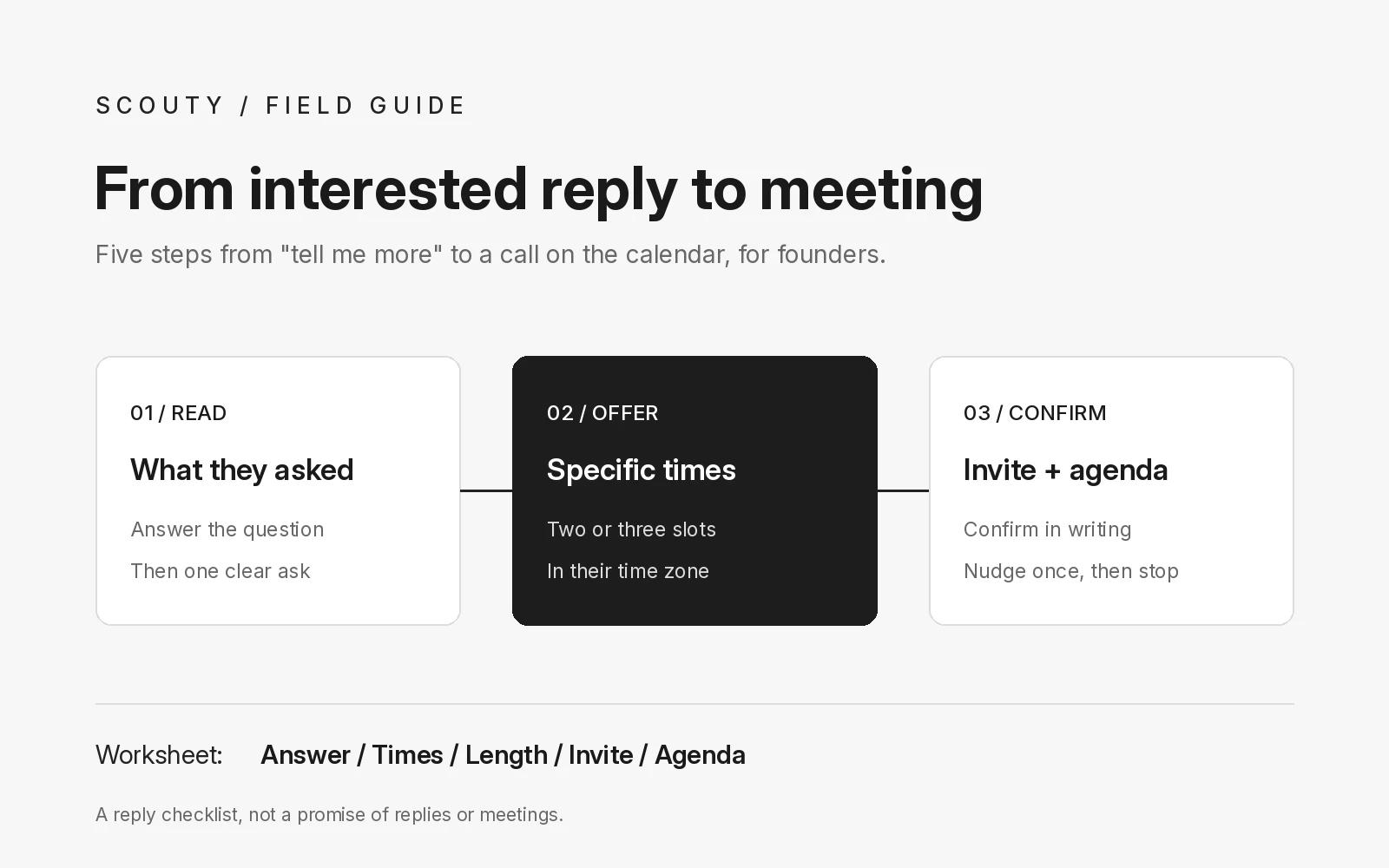
When a prospect writes back "sounds interesting, tell me more", the hard part of outreach is done, and the easy part is where many founders lose the conversation. Turning an interested reply into a booked meeting is mostly about speed, clarity and making the next step small. Answer what they asked, offer a few specific times, and confirm everything in writing.
This guide gives you a five-step routine, a reply template you can copy, and a short checklist. The example below is an illustration, not a measured Scouty result, and nothing here promises that an interested reply will become a meeting.
1. Read the reply for what they actually asked
Interested replies come in a few shapes, and each needs a different answer. Before you write, decide which one you have:
- Ready to talk: they ask for a call or say "let's chat". Your job is to make booking easy.
- Curious but unsure: they ask a question first, such as price, how it works or whether it fits their setup. Answer the question before you ask for time.
- Wrong person: they point you to a colleague. Thank them, then write to that person and mention who sent you.
- Not now: they say later or next quarter. Ask whether they would like you to check back, and only do it if they say yes.
If you are not sure who the right person is, our guide on how to find decision makers at small companies covers how to check before you reply to a referral.
2. Reply while the conversation is still warm
You do not need an instant answer, but you should reply on the same working day if you can. The person was thinking about your message when they wrote back. A quick, short reply keeps the thread in their head and shows that you are paying attention.
Keep it short. Answer their question in two or three sentences, then make one clear ask. Long product tours in a reply give the reader more to read and less reason to book.
3. Offer specific times, not "whenever works"
"Let me know what works for you" hands the planning back to the prospect. Instead, offer two or three specific slots across different days, and state the time zone. If you know where they are based, write the times in their time zone and say so.
A booking page is fine as a backup, but give real times in the email body too, so they can answer with one word. If you use a Google Calendar appointment schedule, Google's help page explains that you set your availability and time zone, and that by default there is a 4-hour minimum lead time before someone can book. Check your page from a private browser window before you share it.
Say how long the call is and what it is for. A 20 minute call to see whether there is a fit is easier to accept than an open-ended demo.
4. Confirm in writing and send an invite
Once they pick a time, reply to confirm it, then send a calendar invite with a clear title, the call link and a two-line agenda. Include their email in the invite so it lands on their calendar, and add any colleague they mentioned only if they asked you to.
A good agenda is plain: what you want to learn about their situation, what you will show, and what a sensible next step would look like. Then prepare. Our guide to preparing for a first prospect meeting walks through the research and questions.
5. If they go quiet, nudge once, then let it rest
Sometimes an interested person stops replying after you send times. Send one short nudge a few working days later that repeats the offer and makes it easy to say no: "Still useful to talk, or should I close this for now?"
If there is still no answer, stop. If anyone asks you not to contact them again, honor that straight away and record it. Our post on cold email follow ups that stop when they should explains why a sequence should end when a reply arrives.
Copy this reply template
Use it as a starting point and rewrite it in your own words:
Hi [first name], thanks for getting back to me. [One or two sentences that answer their question.] Would a 20 minute call help to see whether this fits [their company]? I could do [day and time], [day and time] or [day and time] ([time zone]). If another time is easier, just tell me and I will send an invite.
Reply-to-meeting checklist
- Did I answer the question they actually asked?
- Did I offer two or three specific times with a time zone?
- Did I say how long the call is and what it is for?
- After they picked a time, did I confirm in writing and send an invite with an agenda?
- If they went quiet, did I send one nudge and then stop?
- Did I record any request to stop contacting them?
An illustration: Harbor Lane Studio
Example, fictional company: Harbor Lane Studio, a small design agency. Its founder replies to your first email: "Interesting. Does this work with our existing project tool?" You answer that question in two sentences, then offer Tuesday at 10:00, Wednesday at 14:00 or Thursday at 11:00, in her time zone. She picks Wednesday. You confirm by email and send an invite titled "Harbor Lane x [your company]: 20 minute fit check" with a two-line agenda.
Harbor Lane Studio is an illustration, not a customer or a measured result.
Where Scouty fits
Scouty at scouty.to is built for founders and small B2B teams without an SDR. You start with your website, Scouty researches matching companies and decision makers, and it writes one personal email per person that you review before sending. Optional follow-ups wait at least three days, send on weekdays only, and stop when someone replies.
For the step this guide covers, you can connect a Google Calendar to a project. According to the Scouty site, when someone replies wanting to talk, Scouty books the time they asked for if you are free, and otherwise drafts a reply with open times for you to review and send. You can turn automatic booking off at any time. Scouty does not guarantee replies or meetings. The Scouty FAQ covers meeting booking, follow-ups and pricing.
Questions about turning replies into meetings
Should I send a booking link or specific times?
Specific times in the email body, with a booking link as an optional extra. Specific times let the prospect answer in one word, while a link alone asks them to do the planning.
What if they ask for pricing before agreeing to a call?
Answer it. If your pricing is public, link to it and give the short version. Dodging the question to force a call tends to cost trust.
How many times should I nudge after an interested reply?
Once is usually enough. One short nudge that makes it easy to say no respects their time. After that, let the thread rest unless they come back.
What should I do if they forward me to a colleague?
Thank the person who replied, write to the colleague, mention who referred you, and keep the email short. The cold email template a founder would reply to works for that first message too.
Sources and next step
Outside source, checked 13 November 2026: Google Calendar Help, Create an appointment schedule. Related reading on Scouty: preparing for a first prospect meeting, cold email follow ups that stop when they should, a cold email template a founder would reply to, how to find decision makers at small companies, and the founder-led sales weekly routine.
For product details, read the Scouty FAQ. To find companies and decision makers that match your offer, enter your website at scouty.to and review every email before it goes out.