How to prepare for your first B2B prospect meeting
Build a useful meeting brief from an interested reply: evidence, assumptions, agreed logistics and questions worth asking.
Scouty ·
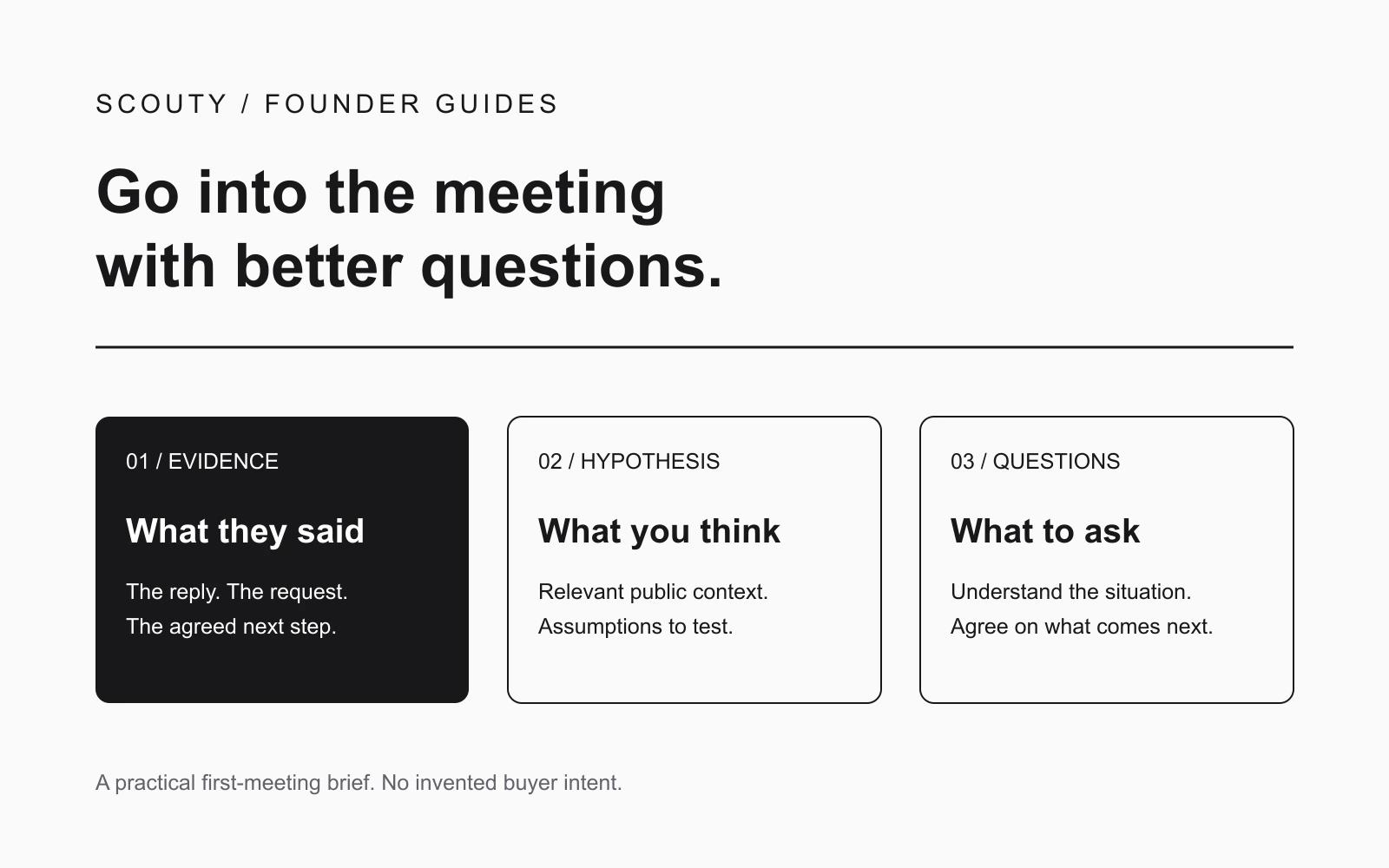
An interested reply is the start of a conversation. Before your first B2B prospect meeting, prepare a short brief that separates what the person said, what you learned from public sources, and what you still need to ask. Agree on the meeting details separately. This gives you a useful agenda without turning guesses into buyer facts.
This guide is for founders running their own sales conversations. The worksheet and examples are practical suggestions, not a tested conversion formula. You do not need a long presentation to use them.
1. Start with the reply, not your pitch
Copy the relevant part of the reply into your private meeting notes, alongside its date and the next action requested. Keep it short and accessible only to the people who need it. Do not paste private conversations into public content or share them with tools unnecessarily.
“Send more detail” is a request for information. “Can we talk next week?” opens a scheduling conversation. Neither tells you the person's budget, buying authority or deadline. Answer the request they made before deciding what you want to sell.
If the reply declines your offer, respect that decision. If it asks a question, answer it. If the person agrees to a conversation, prepare around the subject they agreed to discuss. For the earlier stage, see our guide to follow-ups that stop when they should.
2. Agree on logistics before treating a meeting as booked
Write down the calendar date, time zone, start time, duration and participants. “Tuesday at two” leaves room for different interpretations. Ask for clarification rather than guessing a zone from a company address. Include a simple purpose in the invitation so the recipient knows what the conversation is for.
Check the relevant calendar before offering a slot and again before creating the agreed event. If availability cannot be retrieved, verify it another way before promising the time. Google's Freebusy documentation distinguishes calendar errors from busy intervals; a failed lookup is not evidence of an empty calendar.
Keep the invitation and the guest's response separate in your notes. Google's event reference records event status separately from attendee response: a guest may not have responded, may have accepted, or may have declined. An event on your calendar does not by itself establish that the guest accepted. Acceptance still does not prove attendance or a qualified sales opportunity.
3. Research only what will change your questions
Review the company's own website, the relevant product or service page, and the person's public professional role. Record the source and when you checked it. Focus on facts that help explain why this conversation could be useful; avoid collecting unrelated personal details.
Split your notes into observation and hypothesis. “The website lists three regional offices” is an observation. “Coordinating work across offices may be difficult” is a hypothesis to test. It is not evidence that the company has a coordination problem. Ask how the work happens today rather than opening with a diagnosis.
If you cannot explain why the company fits, revisit the first prospect-list worksheet. Keep this meeting brief focused on the specific conversation instead of repeating your entire prospect research file.
4. Copy this first-meeting brief
Use these fields in a private document. Leave unknowns blank or mark them “not established.” The aim is to make uncertainty visible, not to complete every field before the call.
- Reply evidence: the relevant words, date and requested next step.
- Agreed purpose: what both sides expect to discuss; who agreed to it.
- Logistics: calendar date, named time zone, duration, participants, meeting link and latest RSVP.
- Public context: one or two relevant observations, each with its source and date checked.
- Working hypothesis: one possible problem you want to understand, explicitly labelled as a hypothesis.
- Open questions: what would confirm, change or disprove your understanding?
- Useful example: one truthful example or demonstration relevant to the discussion; label invented examples as fictional.
- Follow-through: leave space for the action, owner and date actually agreed during the conversation.
5. A fictional example: information first, meeting second
Northline Studio is a fictional design business. Its founder receives: “Could be useful—send more detail first.” The founder records a request for information, not a booked meeting. Budget, urgency and purchase intent remain unknown.
A suitable response could be: “Here is the short outline you asked for: we review the current onboarding flow, identify points to investigate, and propose a focused design task. Is there a particular part of onboarding you want me to explain?” This is an illustrative response, not a proven script. Use only a description that matches what your own business actually provides.
Suppose the prospect later agrees to a 20-minute conversation at 2 PM Melbourne time on a specified Tuesday. The founder confirms the actual date, checks availability and sends the agreed invitation. In the brief, the purpose is “understand the current onboarding process,” not “close an urgent redesign project.” If the invitation is still unanswered, record that separately from the email agreement.
The founder sees a public page describing a new self-service plan. Observation: the plan appears on the website. Hypothesis: onboarding needs might differ between self-service and assisted customers. Question: “How does onboarding work for each group today?” Nothing in this example establishes a customer result, budget or sale.
6. Prepare questions that can change your mind
Choose a small set of questions you can listen to properly. Start with the situation before discussing your solution. These prompts are a suggested agenda, not qualification rules every buyer must pass.
- What prompted you to explore this now?
- How is this work handled today, and where does it become difficult, if anywhere?
- What have you already tried, and what did you learn?
- What would make a next step worthwhile for you?
If the answers contradict your research, update your notes. If there is no useful next step, say so. You can offer a relevant example once you understand the situation; avoid presenting a speculative diagnosis as if the prospect already confirmed it.
7. Leave with an agreed next step, or a clear stop
At the end, summarize what you heard and ask whether you understood correctly. Record any action with an owner and a date. “I will send the two-page outline on Thursday” is clearer than “follow up soon.” If they do not want to continue, record that instead of inventing a future commitment.
Keep your reporting equally precise: an interested reply, an invitation, an accepted invitation, an attended meeting and a sale are different events. Use the evidence you actually have for each. A pleasant call does not establish an opportunity value.
Where Scouty fits
Scouty at scouty.to helps founders research companies and contacts from a website and prepare outreach. You can explore research and drafts without an account; saving work or sending requires signing in. Review its current product workflow and FAQ before choosing which steps to use.
Use the brief above to prepare for the human conversation after a reply. Before relying on sending or scheduling automation, use our tool-evaluation checklist to inspect the controls and failure handling. Research and an invitation cannot guarantee a reply, attendance or a sale.
Start with your website in Scouty to research relevant prospects and review your draft outreach. Bring the questions you still need answered to the meeting.