Buying signals: how to tell a company is ready to buy (and when it isn't)
Buying signals for founders: which public, dated changes suggest a company is ready to buy, which ones mislead, and a checklist to score each company before you write.
Scouty ·
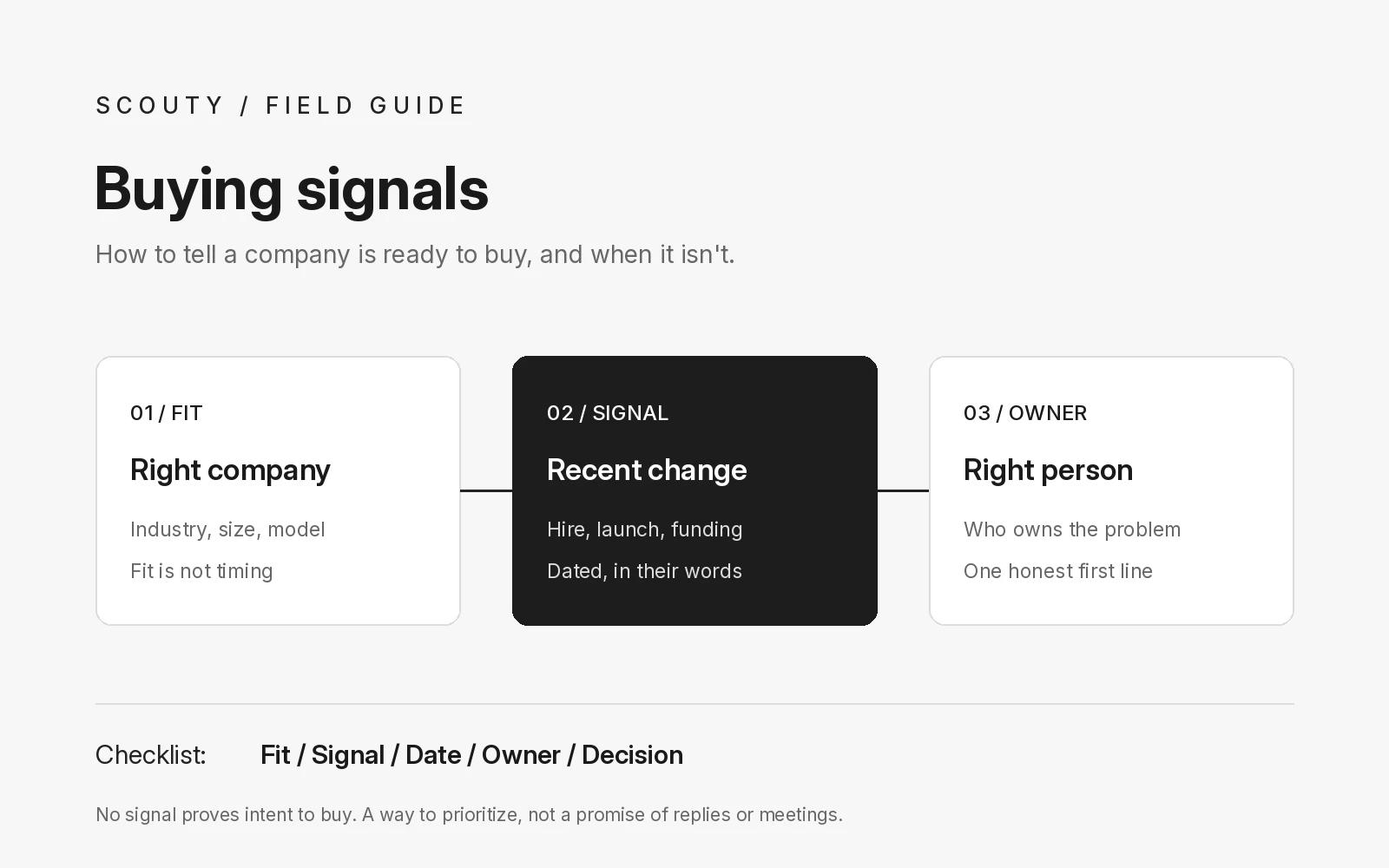
Buying signals are public, dated facts that suggest a company has the problem you solve and a reason to deal with it now. The short answer: look for a recent change, such as a new hire, a new product, new money or a new leader, that connects directly to your offer, then confirm there is a person who owns the problem. Company size, a famous logo or a tool on their website tell you about fit, not timing.
Below: five steps to separate real buying signals from noise, the signals that often mislead, a checklist to copy, and a short illustration. No signal proves that anyone wants to buy, and nothing here promises replies or meetings. It is a way to decide who deserves your time first.
1. Separate fit from timing
Fit and timing are different questions. Fit asks whether this is the kind of company you can help: industry, size, business model, location. Timing asks whether something has changed recently that makes your problem more urgent for them than it was last month.
A list built only on fit is a directory. Everyone on it could buy one day, so nothing tells you who to write to this week. Start with fit, as in our guide to building a B2B prospect list from your website, then use buying signals to decide the order.
2. Look for changes that connect to your offer
A strong signal is a change you can see in public, with a date, that touches the exact problem you solve. Good places to look:
- Hiring for the role your product supports. A careers page asking for someone to own the work you help with suggests the problem is on the table. Save the posting date and the exact wording.
- A new product, plan or market. A launch page, a new pricing page or a move into a new country can create new work for sales, support, marketing or finance.
- New funding. In the US, companies selling securities under a Regulation D exemption file a Form D notice with basic details such as the executive officers, offering size and date of first sale, which you can look up in the SEC's EDGAR database. Money in the bank is not a plan to spend it with you, so pair it with another signal.
- A leadership change. In the UK, Companies House lets you see current and resigned officers for free, and you can set email alerts for changes such as a new director. A new leader may review how things are done, but check what they actually say before assuming it.
- The company names the problem itself. A blog post, job description, interview or changelog where they describe the exact pain you solve is often the clearest signal of all, because it is in their own words.
3. Know the signals that aren't
Some things feel like buying signals but say little about timing. Treat them as background, not as a reason to write today:
- Size or a famous name alone. A large company has many problems; that does not mean it has yours right now.
- A technology on their site alone. Using a tool tells you what they chose, not that they are unhappy with it.
- Old news. A funding round or launch from long ago is history. Use the date, not the headline.
- Opens, clicks and likes. An email open, a link click or a social like is not a request to talk. Do not reply to it as if it were.
- Unrelated hiring. A company hiring engineers does not need your accounting service because it is growing in general.
- "Everyone in this industry needs this." That is your hypothesis, not their signal.
4. Check recency and who owns the problem
Write the date next to every signal you record. Then decide your own freshness window for your market, for example treating anything older than one quarter as background. That window is a working rule for you to adjust, not an industry benchmark.
A signal without an owner is not ready either. Find the person whose job the change affects: often the founder in a small company, or the new hire's manager. Our guide on how to find decision makers at small companies covers this step. To keep watching a shortlist without checking every site by hand, a Google Alert on each company name sends you an email when new search results appear.
5. Score the company, then write one honest sentence
Run each company through the checklist below. If it has fit, a recent signal tied to your offer, and a named owner, it goes to the top. If it has fit but no signal, keep it in research and look again later. If the only signal is on the "aren't" list, leave it.
Then write a first line that states what you observed, without claiming to know their internal results. "I saw you're hiring your first customer support lead" is honest. "Your support is clearly struggling" is a guess. Our cold email template a founder would reply to shows how to build the rest of the message around that line.
Buying signals checklist
Copy this into a doc and fill it in for each company before you write:
- Company and website: ...
- Fit: does it match my ideal company on industry, size and model? yes / no
- Signal observed, in the source's own words: ...
- Source link and date checked: ...
- Why this signal connects to my offer, in one sentence: ...
- Is it on the "aren't" list (size, tool, old news, opens, unrelated hiring)? yes / no
- Inside my freshness window? yes / no
- Person who owns the problem, and their email label: ...
- Decision: write now / keep researching / leave
An illustration: Fernpoint Analytics
Example, fictional company: Fernpoint Analytics, a small reporting software startup that sells to online shops. The founder finds two prospects. Shop A is a well known brand with no recent changes. Shop B posted a job yesterday for its first data analyst and wrote in the listing that weekly sales reports are built by hand. Shop A has fit only, so it stays in research. Shop B has fit, a dated signal in its own words and an obvious owner, the head of e-commerce who will manage the new hire. The founder writes to Shop B first, opening with the job listing.
Fernpoint Analytics and both shops are illustrations, not real companies, customers or measured results.
Where Scouty fits
Scouty at scouty.to is for founders and small B2B teams without an SDR. You enter your website, and Scouty finds matching companies and decision makers. Each email is labeled verified, unverified or unavailable. Scouty writes one personal email per person, and you review it before it is sent. Optional follow-ups wait at least three days and send on weekdays only, with up to three follow-ups per person. When someone wants to talk, meeting booking works through Google Calendar.
Scouty does not guarantee replies or meetings. Use the checklist above on the companies it finds, and keep the ones with a real, recent reason to talk at the top of your list.
Questions about buying signals
Is a funding round a buying signal?
It can be part of one. It tells you a company has new money, not what it will spend it on. Look for a second signal, such as a hire or a stated problem, that links the money to your offer.
Someone opened my email several times. Should I follow up now?
Treat it as noise. An open is not a request to talk. Follow your normal schedule, and stop when they reply or ask you to. Our guide to cold email follow-ups that stop when they should explains the stop rules.
How many signals do I need before I reach out?
One clear, recent signal tied to your offer, plus a person who owns it, is enough to write a relevant first email. Several weak signals do not add up to one strong one.
What should I do with companies that have no signal?
Keep them in research if they fit, and check again later. A weekly prospecting routine makes it easier to revisit them without starting from scratch.
Sources and next step
Outside sources, checked 25 November 2026: Investor.gov, Form D; GOV.UK, Get information about a company; Google Search Help, Create an alert.
Related reading on Scouty: building a B2B prospect list from your website, how to find decision makers at small companies, a cold email template a founder would reply to and a weekly prospecting routine for founder led sales.
For product details, read the Scouty FAQ. To find companies and decision makers that match your offer, enter your website at scouty.to, check each one for a real buying signal, and review every email before it goes out.