Cold email opt out: how to honor every "please stop" request
How to handle a cold email opt out: treat any "please stop" as a stop, act the same day, keep one do-not-contact list, and know what CAN-SPAM, GDPR and Decree 91 say.
Scouty ·
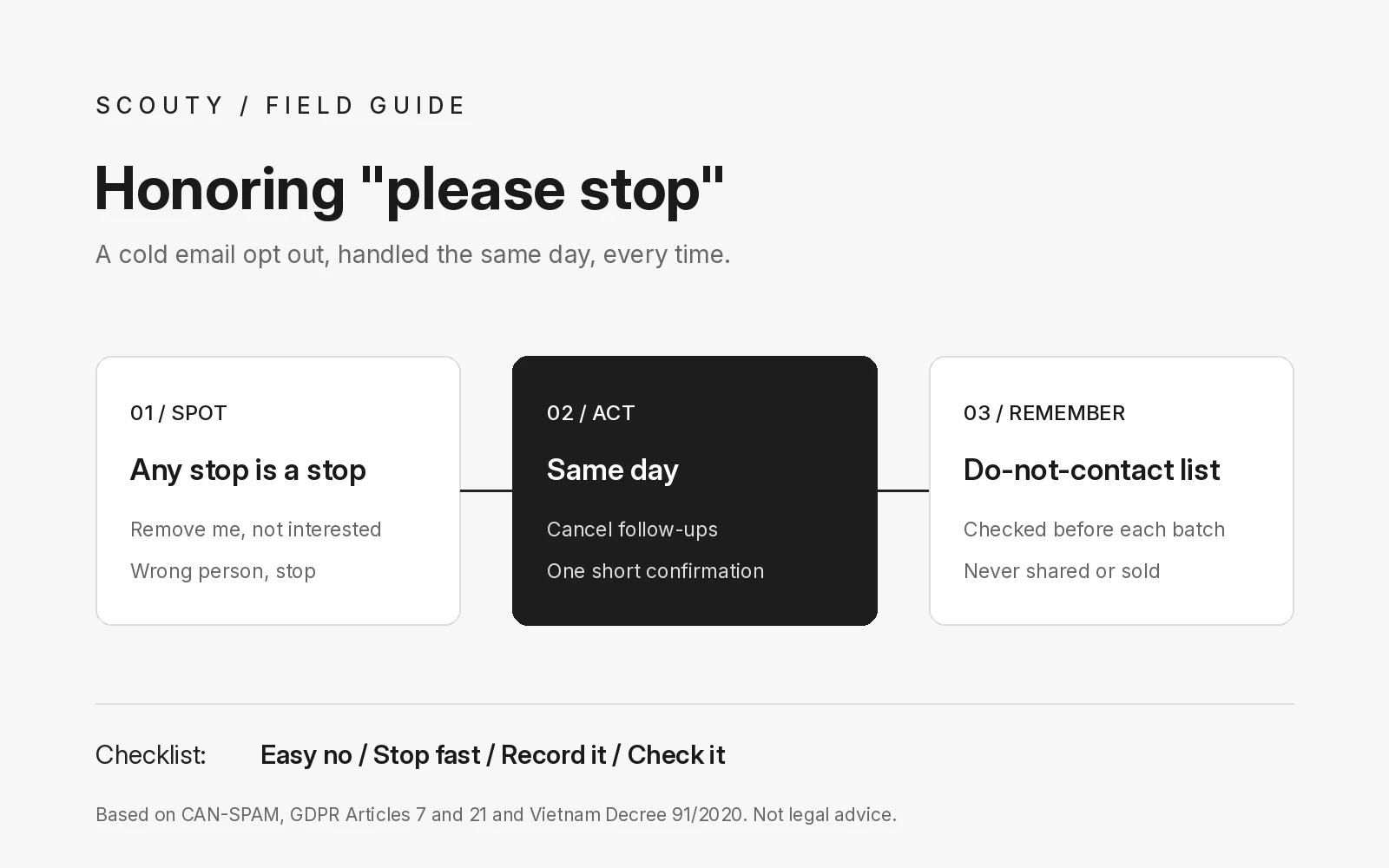
A cold email opt out is any message where the person you wrote to tells you, in any words, that they do not want to hear from you again. The short answer: stop writing to them, stop every planned follow-up, record the request in one place you check before each batch, and never pass their address on. That is good manners, and often the law.
Below: what the US CAN-SPAM Act, the EU GDPR and Vietnam's Decree 91/2020/ND-CP actually say, how to spot a stop request that never uses the word unsubscribe, and a worksheet to copy. This is not legal advice.
1. Treat every kind of "please stop" as a stop
People rarely click a link in a personal email. They write "please remove me", "not interested, don't email again", "wrong person, take me off your list" or just "stop". Treat all of these as a stop request for that person. If it says "nobody here wants this", stop for the whole company.
A plain "not right now" is a reply, not an objection. Our guide to handling prospect replies before booking covers answers in between. When unsure, stop.
2. Know what the main rules say
United States: CAN-SPAM
Under 15 U.S.C. 7704, a commercial email must include a working return email address or other internet based way to ask not to receive more commercial email, and it must keep working for at least 30 days after you send. Once someone asks, you may not send them commercial email covered by the request more than 10 business days after you receive it. You also may not sell or transfer their address, except to comply with the law.
The same section requires a clear notice that the recipient can opt out, a valid physical postal address, and clear identification that the message is an advertisement or solicitation unless the recipient gave prior affirmative consent. The FTC rule at 16 CFR 316.5 adds that you cannot charge a fee, ask for anything beyond their email address and opt-out preferences, or require any step other than a reply email or a visit to a single web page.
European Union: GDPR
Article 21 GDPR gives people the right to object at any time to their personal data being used for direct marketing. Once they object, the data may no longer be processed for that purpose. Article 21 also says this right must be brought to their attention explicitly, at the latest in the first communication, and presented clearly and separately from other information.
If you rely on consent instead, Article 7(3) GDPR says people can withdraw it at any time, and withdrawing must be as easy as giving it.
Vietnam: Decree 91/2020/ND-CP
Decree 91/2020/ND-CP, in force since 1 October 2020, treats advertising email sent without the recipient's prior consent as spam. For advertising email it requires a [QC] or [AD] label at the start of the subject line, sender details (name, phone number, email address, geographic address and website or social page if any) placed just before the opt-out section, and an opt-out section at the end of the email that clearly states the recipient can refuse all of the advertiser's products.
The decree says people must be able to refuse by website or social page, by email and by phone. As soon as a refusal arrives, the sender must send a confirmation and stop sending the refused advertising email. That confirmation is sent once, contains no advertising, and states that the request was received, when it was received and when sending stops. It also requires keeping consent and refusal records for at least 1 year. Check whether a newer decree applies before relying on these details.
3. Make saying no easy in every email
The rules share one idea: people must know how to say no, in one simple step. In a personal email, the simplest version is a closing line such as "If this isn't relevant, reply 'no thanks' and I won't write again." Make sure replies reach a real inbox you read and are not caught by your spam filter.
Whether you also need a postal address, an ad label or an unsubscribe link depends on where your recipients are. Our post on Gmail bulk sender guidelines covers what Google asks on top of the law.
4. Stop everything the same day
The legal deadlines differ, from "immediately" in Vietnam to 10 business days in the US. A simple habit covers all of them: act on a stop request the day you see it. Cancel queued follow-ups, remove the person from every list, and tell teammates who might write to them. Our guide to follow-up emails that stop when they should shows how to build stop rules into a sequence from the start.
5. Keep one do-not-contact list and check it every time
Repeat mistakes usually happen weeks later, when the same person turns up in a new list. Keep one do-not-contact list with the email address, the company domain if they asked for the whole company, the date, and where the request came from. Check it before every batch. Keep only what you need to avoid writing again, and never share or sell it.
Opt-out worksheet
Copy this into a doc and fill it in before your next batch:
- Countries where my recipients are, and which rules I checked: ...
- The line in each email that tells people how to say no: ...
- Reply inbox I read daily, with spam filter checked for stop replies: yes / no
- Phrases I treat as a stop: stop, remove me, unsubscribe, not interested, don't contact, wrong person, ...
- Who acts on a stop request, and by when: same day / ...
- Where my do-not-contact list lives: ...
- Do-not-contact list checked before this batch: yes / no
- Queued follow-ups cancelled for everyone who asked to stop: yes / no
- Short confirmation sent with no pitch, where required or helpful: yes / no
An illustration: Harbor Ledger
Example, fictional company: Harbor Ledger, a three person bookkeeping software startup. Its founder closes each email with "Reply 'no thanks' and I won't write again." One finance lead answers "please take me off your list". That morning, the founder cancels the planned follow-up, adds the address and date to a shared do-not-contact sheet, and replies once: "Done, you won't hear from us again." When a teammate later imports a new list, the sheet catches the address before anything is sent.
Harbor Ledger is an illustration, not a real company, a customer or a measured result.
Where Scouty fits
Scouty at scouty.to is for founders and small B2B teams without an SDR. You enter your website, and Scouty finds matching companies and decision makers. Each email is labeled verified, unverified or unavailable. Scouty writes one personal email per person, and you review it before it is sent. Optional follow-ups wait at least three days and send on weekdays only, with up to three follow-ups. The Scouty FAQ says any reply stops the sequence and that you can stop pending messages at any time.
Scouty does not guarantee replies or meetings, and it does not replace your own do-not-contact list or your duty to follow the email laws that apply to you.
Questions about cold email opt outs
Does an opt-out request still count if they did not click an unsubscribe link?
Yes, treat it as one. CAN-SPAM accepts a reply email as an opt-out, and the GDPR right to object can be used at any time.
Can I email them again later from a different address or product?
Not unless they later ask to hear from you. Decree 91 says people must be able to refuse all of your products, and a GDPR objection ends direct marketing use of their data.
Is this legal advice?
No. This is not legal advice. It summarizes parts of the texts we read. Laws change and depend on where you and your recipients are, so get advice for your situation.
Sources and next step
Primary sources, checked 23 November 2026: 15 U.S.C. 7704, 16 CFR 316.5, GDPR Article 21, GDPR Article 7 and Decree 91/2020/ND-CP in Vietnam's Official Gazette. Related reading on Scouty: follow-up emails that stop when they should, Gmail bulk sender guidelines for small outbound teams and handling prospect replies before booking.
For product details, read the Scouty FAQ. To find companies and decision makers that match your offer, enter your website at scouty.to and review every email before it goes out.